Git Analytics
Git Analytics for Engineering Managers
Use repository evidence in a release discussion
A release discussion benefits from concrete repository facts: changes since the last tag, the available checks, and the proposed release notes. These facts cannot tell you how many hours a team spent or whether a reorganization improved delivery.
The Challenge
Repository evidence is useful only when its scope is clear. Local state, authorized GitHub metadata, and provider events are different sources.
What Git Analytics Means for Engineering Managers
Use activity to locate changes worth inspecting. Do not infer time spent, personal productivity, risk, or business outcomes from volume alone.
Questions Engineering Managers Ask
- •What changed since the last tag?
- •Which checks are available and what do they report?
- •What is still uncommitted in the local checkout?
- •Which release claims have supporting commits or pull requests?
- •What remains uncertain about readiness?
- •Who needs to resolve the outstanding review questions?
How GitGlow Helps
Free provides a starting point for local inspection and one trusted-repository observation. Pro adds concurrent repositories and agents, authorized GitHub context, managed runs, and Release Workspace.
Local repository review stays on the device. Connected GitHub, billing, and optional managed-provider analysis have distinct boundaries; inspect the disclosure before sharing selected evidence.
Use the visible source, time range, and available detail to interpret each view. Remote commit samples are bounded; dirty working-tree state describes now.
A practical review sequence
- Select the repository involved in the release discussion.
- Review relevant commits and available pull-request context.
- Use Pro Release Workspace to inspect readiness and edit the proposed release material.
- Discuss unresolved evidence with the people responsible; publication remains a separate confirmed action.
Updated 2026-09-08 · By Stoyan Korudzhiev
Walk through agent observation, review, and Indie Log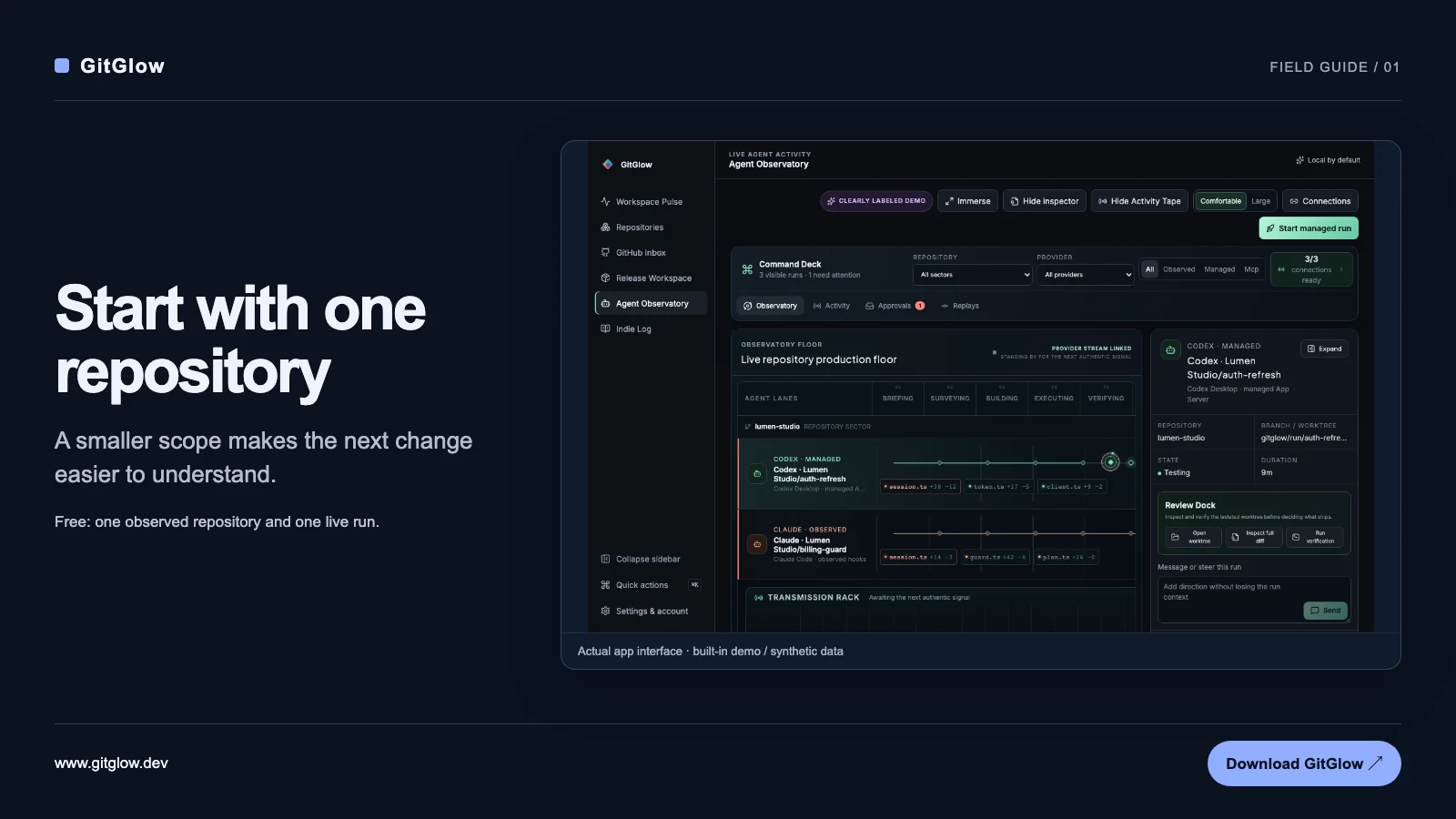
Use this workflow to prepare a concrete decision. GitGlow does not turn repository activity into an employee-performance score.